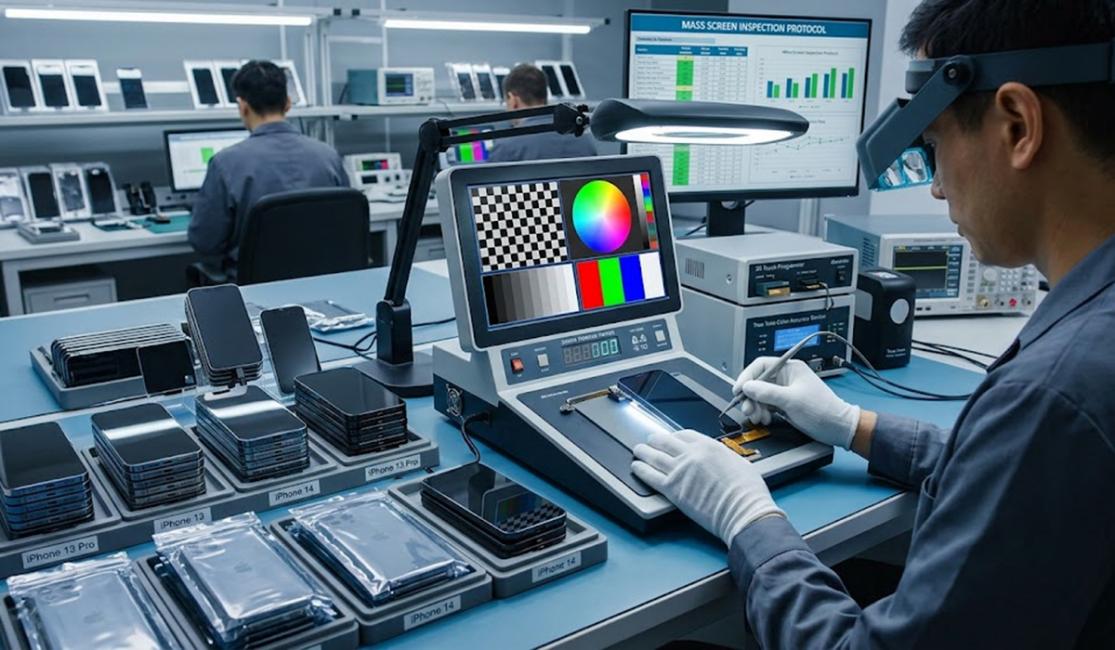
In the mobile phone repair and screen wholesale industry, the bulk procurement of iPhone screens not only directly impacts costs but also determines repair success rates, return rates, and long-term customer satisfaction.
For repair shops, wholesalers, refurbishment facilities, and cross-border sellers, the key to bulk purchasing iPhone screens lies not in price, but in consistent quality and the management of after-sales risks.
Several key points need to be confirmed before making a bulk purchase.
Batch consistency
Screens from the same batch maintain consistent brightness under identical driving conditions, with no visible differences in brightness or darkness.
The color temperature of the white display is stable, with no unit-to-unit variations leaning towards yellow or cool tones.
Grayscale transitions remain consistent at low brightness levels, without localized grayish areas or color banding.
The touch sampling rate is consistent; there is no lag or stuttering when swiping on specific areas of the screen.
Screen type
Different screen types not only determine the price but also directly affect structural thickness, installation fit, and operational stability.
Soft OLED utilize a flexible substrate structure, resulting in a thinner overall profile; the screen can bend slightly to better conform to the phone's middle frame. This design ensures more uniform pressure distribution during installation, minimizing issues such as edge lifting or uneven bonding, making it ideal for high-end repair and refurbishment services.
Hard OLED utilize a glass substrate structure; while they are slightly thicker and offer greater screen rigidity, they are more susceptible to issues such as uneven edge stress or concentrated pressure points if the device body undergoes slight deformation, thereby placing higher demands on the assembly process.
LCD screens utilize a multi-layer structure combining a backlight and a liquid crystal panel; this results in greater overall thickness and weight, and-in some models-may require precise management of the space allocated for ribbon cables, making them better suited for the low-cost repair market..
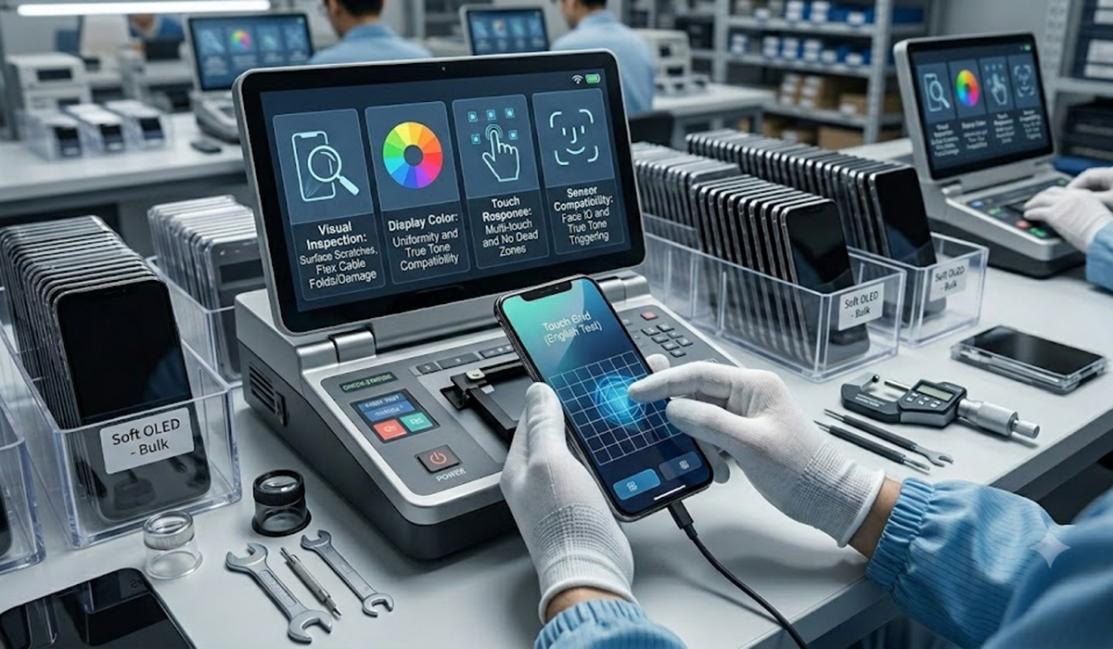
Device Compatibility
The ribbon cable placement is identical to that of the original unit, ensuring there are no issues with pressure or bending after installation.
The Face ID optical area remains unobstructed, ensuring stable facial recognition triggering.
The True Tone function can be successfully restored or written without affecting the original factory color logic.
The auto-brightness sensor responds normally, adjusting stably under varying ambient light conditions.
Touch performance
Touch sampling remains continuous during rapid swiping, with no breaks or lag.
Continuous clicking operations show no missed touches or accidental touches.
Multi-touch operation is free from signal conflicts or drift.
Touch responsiveness at the screen edges matches that of the central area, with no loss of sensitivity.
Display effect
Uniform brightness across the entire screen, with no localized bright spots or dark corners.
The color of the white screen is uniform, with no localized color casts.
Blacks appear pure, without any grayness or haziness.
No significant color shift or slight green tint after prolonged use.
defective rate
Is the ex-factory defect rate stable and traceable?
Are there any latent faults that only appear after use?
Are the defects concentrated in the touch IC, display IC, or structural layer?
Does it support batch-level traceability and holistic issue resolution?
Packaging and Transportation
Individual anti-static packaging to prevent electrostatic damage to the IC.
Rigid partition structure prevents crushing during transport.
Internal fixed structure reduces wobbling.
The outer carton is compression-resistant and suitable for long-distance transport involving stacking.
Supplier stability
Whether the same production scheme and IC configuration are used consistently over the long term?
Does it possess the capability for sustained mass production?
Is the same quality standard maintained during restocking?
Are there issues with frequent changes to the supply chain?
After-Sales Policy
Does it support centralized batch exchanges?
Is the after-sales processing cycle fixed and predictable?
Does it support processing issues in batches?
Are clear warranty standards provided?
Cost structure
Procurement cost
Cost of transportation loss
Cost of installation failure
After-sales repair costs
FAQ
Q:What should you pay attention to when working with a new supplier for the first time?
A: In addition to testing product quality, one should also evaluate the supplier's communication efficiency, delivery times, and problem-solving capabilities.
Q: Is it necessary to request samples before making a bulk purchase?
A: It is necessary. Sample testing helps confirm whether the product meets the needs of the target market and reduces the risk associated with the initial purchase.
Q:Why do delivery lead times vary significantly among some suppliers?
A: Delivery time usually depends on inventory status, production capacity, and order quantity.
Q:When sourcing iPhone screens, should you choose stock items or custom orders?
A: If there are special requirements for brand packaging or product specifications, customized orders are more suitable; if fast delivery is pursued, spot goods are usually a better choice.
Q: Should the same product model be procured from multiple suppliers?
A: Maintaining appropriate backup supply channels helps mitigate the risk of supply disruptions, but an excessive number of suppliers can lead to inconsistent product quality.