

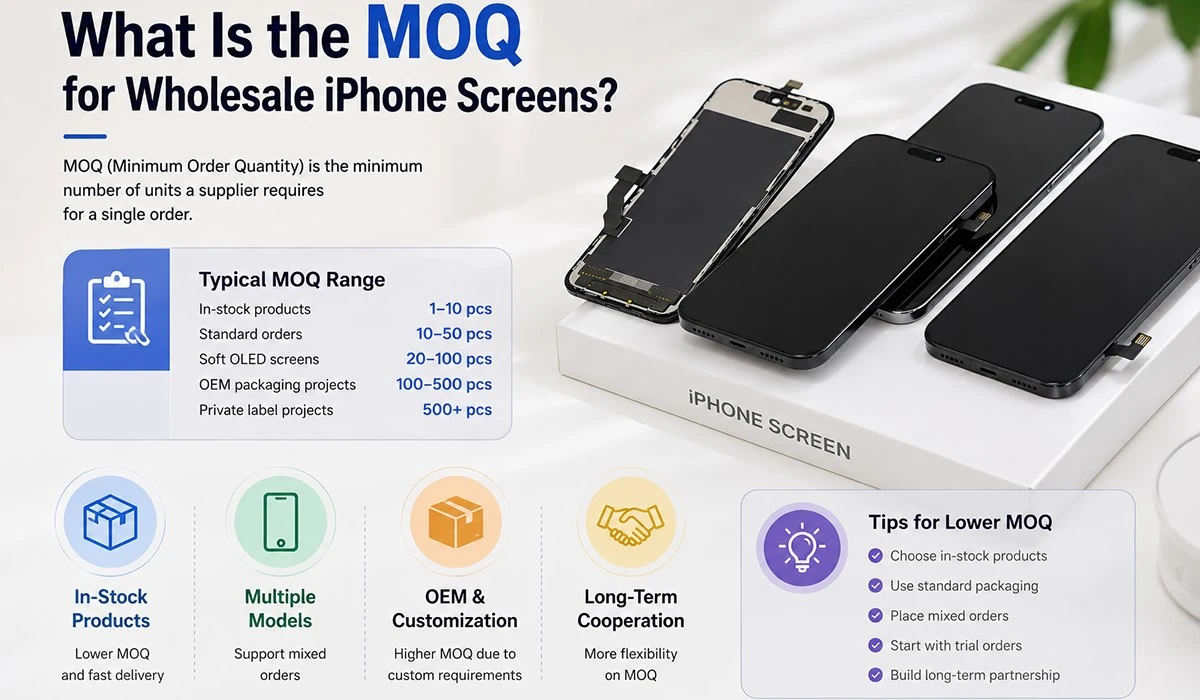
When purchasing iPhone replacement screens, the most frequently asked questions by wholesalers, distributors, repair shops, and refurbishment companies are::What Is the MOQ for Wholesale iPhone Screens?
Typically, the MOQ (Minimum Order Quantity) for wholesale iPhone screens ranges from 10 to 100 pieces, depending on the product type, inventory status, and whether customization services are required. For in-stock products, some suppliers even support single-piece sample purchases; while OEM packaging or private label projects usually require higher MOQ.
MOQ directly impacts inventory planning, procurement costs, cash flow, and supplier selection. Understanding MOQ policies is particularly important for buyers new to the market or preparing to test new products.
It's worth noting that there is no unified MOQ standard in the iPhone screen wholesale industry. Policies vary significantly among different suppliers; therefore, it is essential for buyers to understand the factors influencing MOQ before placing an order.
What is MOQ in iPhone screen wholesale?
MOQ stands for Minimum Order Quantity, which refers to the minimum quantity a supplier requires to purchase a single order.
For example, if a supplier specifies a MOQ of 50 units for the iPhone 16 Pro Soft OLED screen, then customers must purchase at least 50 units before placing an order.
Suppliers set up MOQ primarily for better management:
Raw material procurement costs
Labor costs
Packaging costs
Inventory turnover
Production efficiency
Different suppliers have different business models and production capabilities, so their MOQ policies will also differ.
What is the typical MOQ for wholesale iPhone screens?
Although there is no unified standard in the industry, the common MOQs in the market are roughly as follows:
|
Product Type |
Common MOQ |
|
In-stock screens |
1–10pcs |
|
Standard wholesale order |
10–50pcs |
|
OEM Packaging Projects |
100–500pcs |
|
Own Brand Projects |
100–500pcs |
In actual procurement, most repair shops usually start with a trial order of 10 to 30 pieces, while large distributors often purchase more than 100 pieces for a single model.
Why are the MOQs different for different suppliers?
Many buyers find that some suppliers support orders starting from 10 pieces, while others require orders of 100 pieces or more. The reasons for this difference are mainly as follows.
Product Type
Different display technologies have different production costs.
For example:
Hard OLED screens are in ample supply, and MOQ is typically low.
Soft OLED screen production costs are high, therefore the MOQ is often higher.
Incell LCD screens typically have more flexible MOQ policies.
In addition, the MOQ of newly launched models is usually higher.
Inventory status
Suppliers with ample inventory are generally more flexible.For spot products, buyers often have the following options:
Single sample
Small batch trial order
Mixed batches of multiple models
For products that require a rescheduling of production, the MOQ requirement is usually higher.
OEM and customization needs
Customization is one of the key factors affecting MOQ.
For example:
Customized packaging
Logo printing
Own Brand Customization
Customized antistatic bags
Customized brand accessories
OEM projects typically require higher minimum order quantities due to the additional costs involved in design, printing, and production preparation.
Production costs
Even with small order quantities, factories still need to complete processes such as testing, packaging, quality inspection, and shipping. To ensure operational efficiency, suppliers typically set an MOQ.
Supplier's business model
Some suppliers primarily cater to repair shops, thus supporting lower MOQ orders; while others mainly serve large wholesalers and distributors, with relatively higher MOQs. Understanding a supplier's target customer base helps in better understanding their MOQ policy.
Do wholesale suppliers support small-batch trial orders?
Supported. Many professional suppliers offer trial orders for first-time clients, which can help buyers evaluate their options.
Product quality
Display effect
Touch sensitivity
Packaging quality
Shipping speed
Communication efficiency
After-sales service
For example, a Mexican repair shop might first purchase:
10 pcs iPhone 16 screens
10 pcs iPhone 15 screens
5 pcs iPhone 14 screens
This procurement method allows for testing local market demand while reducing inventory risk.Therefore, most professional suppliers welcome customers to place trial orders first as a basis for establishing long-term cooperative relationships.
Can different models be mixed in bulk?
In most cases, yes.Many iPhone screen wholesale suppliers support mixed batches of multiple models.For example, a buyer can purchase in the same order:
10 pcs iPhone 16 screens
10 pcs iPhone 15 screens
10 pcs iPhone 14 screens
Mixed batches have the following advantages:
Reduce inventory pressure
Reduce procurement risks
Improve capital turnover efficiency
To meet more customer needs
For repair shops, mixed batches are usually the most practical purchasing method.
How to achieve a lower MOQ?
Select in-stock products
Suppliers have already prepared the goods in advance, so there is no need for additional batch production scheduling. Therefore, there is no high minimum order quantity threshold. Even if the buyer only purchases a small number of screens of a few models, the minimum order quantity can be met. This is very suitable for mobile phone repair shops with small scale and low single-order quantity.
Use standard packaging
Using standard packaging provided by the factory, rather than OEM customized packaging, can significantly reduce the minimum order quantity (MOQ) requirement.
Mixed batch method
Purchasing multiple different models in combination makes it easier to meet the supplier's minimum order requirements.
Starting with a trial order
Small-batch trial orders can help both buyers and sellers gradually build trust and cooperation.
Establish long-term cooperative relationship
For long-term, stable purchasing clients, suppliers are usually more willing to offer them more flexible MOQ policies.
Is a lower MOQ always better?
Not necessarily. While a low MOQ can improve purchasing flexibility, it is not the only criterion for selecting suppliers. Buyers should also focus on:
Product quality stability
Warranty Policy
Quality control system
Delivery stability
Production capacity
Long-term supply capability
Even if some suppliers have a slightly higher minimum order quantity (MOQ), if they can consistently provide stable product quality and comprehensive after-sales service, these suppliers are often more worthy of long-term cooperation.
Are there any procurement schemes without MOQ?
Some suppliers do offer MOQ free services, especially for in-stock items and sample orders.
However, buyers should note that very small batch orders typically have higher unit prices because fixed costs cannot be amortized through large-volume purchases.
Therefore, MOQ free solutions are more suitable for sample testing and not for long-term bulk purchases.