

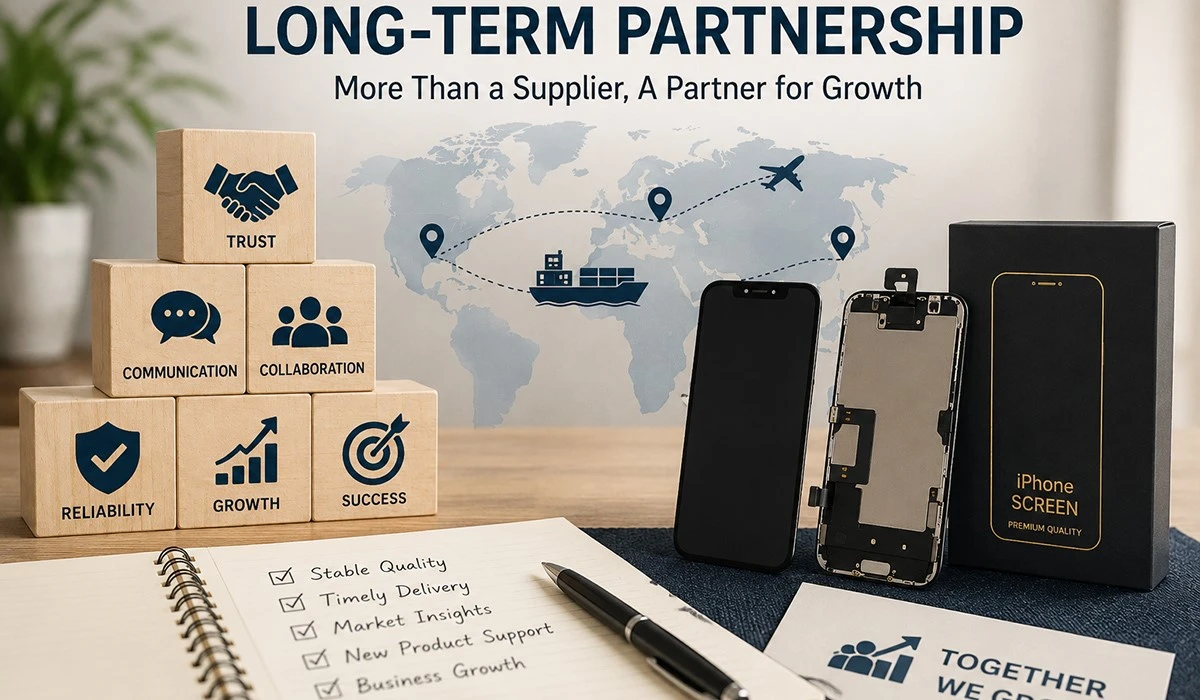
How to find a long-term iPhone screen manufacturing partner?
In the highly competitive mobile phone repair industry, finding an iPhone screen supplier isn't difficult, but finding a manufacturing partner that can sustain a business for many years is no easy feat.
Many repair businesses frequently change suppliers, typically due to unstable supply, inconsistent product quality, inefficient communication, or inadequate support. Frequent supplier changes often drive up operating costs and hinder long-term business development.
A truly qualified long-term manufacturing partner not only provides products but also supports business expansion, adapts to market changes, and helps clients achieve their long-term development goals.
So, how should buyers find a suitable long-term iPhone screen manufacturing partner?
Why are long-term partnerships more important than short-term deals?
Choosing a supplier solely based on short-term price advantages often leads to hidden risks.
Long-term partnerships can help businesses:
Maintain stable product standards
Reduce supply disruption risk
Simplify procurement management processes
Improve inventory planning efficiency
Improve customer satisfaction
Achieve more predictable business growth
For maintenance companies in their growth stage, supply stability is often more important than short-term cost savings.
Choose partners who can grow together with the company.
Before establishing a long-term partnership, buyers are advised to consider the following questions:
When order volume increases, will the manufacturer be able to maintain its supply?
As their business expands, will they be able to offer more product categories?
After the new iPhone is released, will they be able to launch a corresponding product in a timely manner?
When companies expand into overseas markets, do they have the global logistics support capabilities?
Businesses need scalable partners to grow. If manufacturers cannot grow alongside the company, they may become a bottleneck for future business development.
Assessing a manufacturer's ability to respond to market changes
The mobile phone repair market changes rapidly. New iPhone models are released every year, and market demands and customer preferences are constantly evolving. Therefore, long-term partners must have the ability to respond quickly to market changes.
For example:
After the new iPhone is released, how long will it take them to launch compatible screen products?
When popular models are out of stock, can they quickly replenish them?
When market trends change, can they promptly launch upgraded and compatible products?
Manufacturers who can respond quickly to market changes are often able to help their clients seize new business opportunities more quickly and maintain their market competitiveness.
Assess collaboration efficiency, not just transaction efficiency.
Many buyers focus solely on price and delivery speed when selecting suppliers. However, long-term, stable cooperation depends more on the efficiency of collaboration between both parties.
The following aspects can be prioritized for evaluation:
Are they able to communicate proactively?
Excellent partners proactively share information before problems arise, rather than passively notifying customers after delays occur. They also proactively share inventory status, production plans, and market updates, rather than notifying customers only after problems occur.
Do they possess the ability to solve problems efficiently?
In the process of international trade, emergencies such as logistics delays, supply shortages, and technical failures are often unavoidable. What really matters is whether manufacturers are willing to take the initiative and come up with feasible solutions quickly.
Are they transparent enough?
Long-term cooperation relies on transparent information sharing. Manufacturers should promptly inform customers of inventory status, delivery cycles, and any potential production adjustments. Open and transparent communication helps build long-term trust and reduces misunderstandings.
Choose a manufacturer that can support brand development.
As market competition intensifies, more and more wholesalers and distributors are starting to build their own brands. Therefore, long-term partners should not only provide products, but also support their clients in brand building.
For example:
OEM Custom Packaging
Own-brand services
Logo printing
Customized Labels
Product images and promotional materials support
These value-added services can help customers enhance brand awareness and strengthen brand loyalty among end customers.
Focus on strategic value beyond products
The value that a good manufacturing partner can provide goes beyond the product itself.
They may also provide the following to customers:
Industry trend analysis
Hot Selling Products Recommendation
Inventory planning recommendations
New product launch information
Maintenance technical guidance
This support enables buyers to make more accurate purchasing decisions and maintain their market competitiveness.
Build trust through gradual cooperation
Long-term cooperative relationships cannot be established immediately; buyers can gradually build trust between the two parties in multiple stages.
Phase 1: Trial Order Cooperation
Evaluation through small-batch trial orders:
Product quality
Packaging quality
Shipping efficiency
Communication efficiency
After-sales response capability
Phase Two: Routine Procurement
Establish a stable and routine procurement process, while continuously observing the other party's actual performance in long-term cooperation.
Phase Three: Strategic Cooperation
Once sufficient trust is established, both parties can further develop deeper cooperation, for example:
Annual Procurement Plan
OEM Customization Projects
Joint market development
This gradual cooperation model can effectively reduce cooperation risks and help both parties establish a more stable business relationship.
What is the difference between a manufacturing partner and a regular supplier?
|
Ordinary suppliers |
Long-term manufacturing partner |
|
Focus on a single transaction |
Focus on long-term common growth |
|
Mainly selling products |
Provide business support and collaboration |
|
Focus on short-term profits |
Emphasis on long-term cooperation |
|
Limited customization capabilities |
Offers flexible OEM and brand support |
|
passive communication |
Proactive communication and collaboration |
A true manufacturing partner sees their customer's success as part of their own.
Choosing a long-term partner is a strategic decision.
For repair shops, wholesalers, and distributors, choosing a long-term partner for an iPhone screen manufacturer is not only related to product procurement efficiency, but also directly affects the company's future development potential and market competitiveness.When evaluating potential partners, buyers can focus on the following aspects:
Can you understand the client's business model and long-term development goals?
Can you continue to provide support as your business grows?
Can it quickly respond to market changes and continuously launch new products?
Can you provide flexible OEM, brand customization, or business cooperation solutions?
Are you willing to maintain open, transparent, and continuous communication?
Do we place greater emphasis on long-term partnerships rather than just single-order transactions?
When a manufacturer not only focuses on product sales but is also willing to work with customers to plan for future development and continuously create value for them, such a partnership is more likely to develop into a true long-term strategic partnership.