

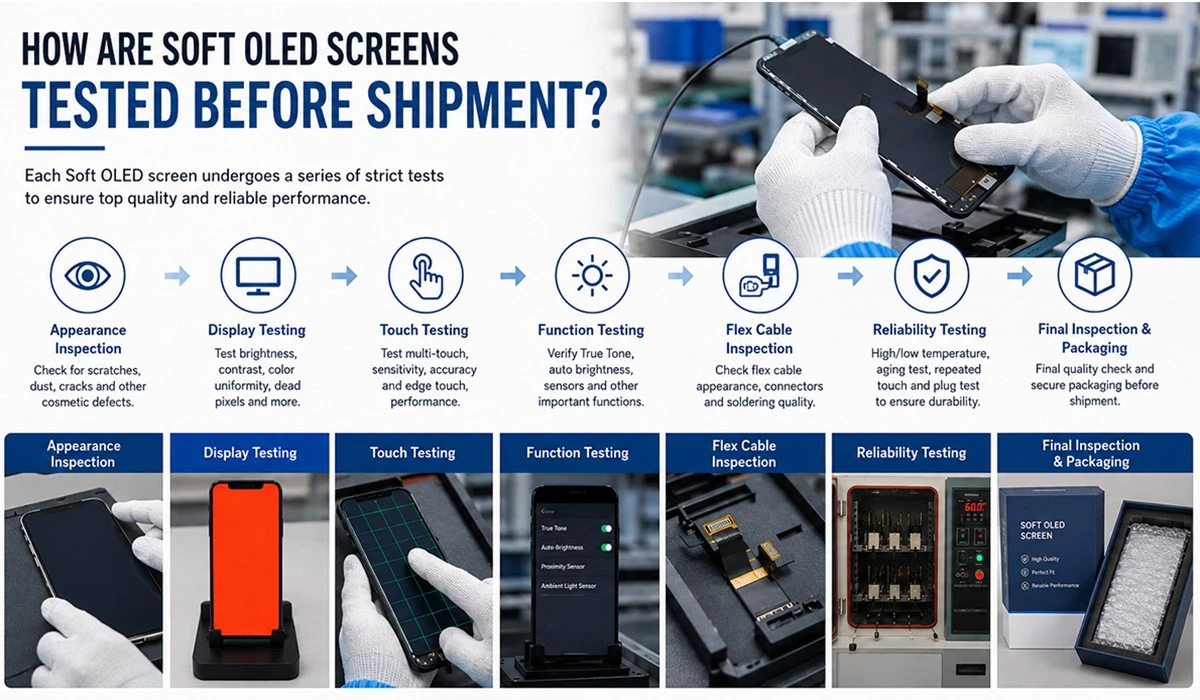
How Are Flexible OLED Screens Tested Before Shipment
For wholesalers, distributors, chain repair shops, and refurbishment companies, product quality is consistently one of the most important considerations when purchasing flexible OLED screens in bulk.
A defective screen entails far more than just the simple replacement of a product; it can also lead to additional labor costs, customer complaints, after-sales claims, negative reviews, and even the loss of future partnership opportunities.
For this reason, an increasing number of professional buyers are focusing not only on the screen's place of manufacture but also-and especially-on the quality inspections performed on the product prior to shipment.
So, what specific tests do flexible OLED screens undergo before shipment?
Professional manufacturers typically implement multiple quality control procedures throughout the production process. Before leaving the factory, screens generally undergo various checks-including visual inspection, functional testing, compatibility verification, and reliability testing-to ensure stable performance and minimize after-sales risks.
Why is pre-shipment inspection so important?
Unlike many electronic components, a mobile phone screen directly impacts the end user's experience.
Once repairs are complete, the customer immediately notices the display quality, touch sensitivity, brightness, and overall user experience.
In the absence of a robust testing process, defective products could enter the market, potentially leading to:
Higher return rates
Increase after-sales costs
Increased customer complaints
Additional labor costs
Lost potential customers
Damage to corporate brand reputation
For professional buyers, choosing a supplier with a rigorous quality control system is just as important as choosing the right screen type.
Outgoing testing process for soft OLED screens
Although testing procedures may vary between different factories, professional suppliers typically follow standardized testing procedures:
Preliminary visual inspection
Display function test
Touch performance test
Functional compatibility verification
Cable testing
Reliability and aging tests
Final quality inspection
Packaging confirmation before shipment
Through multi-stage testing, the factory can ensure that only products that meet the standards can be shipped to customers.
1.Appearance inspection
The first step in the inspection process is usually a visual inspection.
Technicians will carefully inspect each screen under professional lighting conditions to ensure that there are no defects in the product's appearance before proceeding to the next step of functional testing.
The main testing items include:
Are there scratches on the glass surface?
Are there any cracks or warping?
Are there any dead or bright pixels?
Are there any dust or foreign objects?
Does the polarizer have defects?
Is the mid-frame damaged?
Is there any glue overflow?
Is there contamination on the surface?
Are there any abnormalities in the assembly process?
Only products that pass the visual inspection can proceed to the next stage.
2.Display function test
After passing the visual inspection, the flexible OLED screen is connected to professional testing equipment for display testing.
Once the screen is turned on, technicians will conduct a comprehensive inspection of its display performance.
Test content typically includes:
Can the screen turn on normally?
Is the brightness uniform?
Are the colors consistent?
Contrast performance
Color display effect
White balance accuracy
Full-screen display status
Technicians typically display multiple solid color images separately, for example:
Pure white
Pure black
Red
Green
Blue
These tests can quickly reveal:
Dead pixels
Checkpoint
Color deviation
Uneven brightness
Display error
Light leakage problem
3.Touch function test
Touch performance is one of the key factors affecting user experience.
Every flexible OLED screen needs to undergo complete touch testing to ensure that the touch function works properly.
The main test content includes:
Full-area touch response
Multi-touch functionality
Touch sensitivity
Slide operation performance
Gesture recognition capability
Edge area touch response
Professional testing equipment simulates real user operating habits to ensure a stable and accurate touch experience across the entire screen area.
If touch latency, touch malfunction, or accidental touches are detected, the product is immediately deemed unqualified.
4.True Tone and Functionality Compatibility Testing
For many iPhone users, retaining original functionality after repair is equally important.
Therefore, high-quality flexible OLED manufacturers typically also perform compatibility verification for the following functions:
True Tone display support
Automatic brightness adjustment
Proximity sensing function
Ambient light sensing function
These tests ensure that the repaired equipment provides a user experience as close as possible to the original.
This is especially important for the high-end repair market and refurbishment business.
5.Cable testing
The ribbon cable connects the screen to the motherboard and plays a crucial role in signal transmission.
A problem with the ribbon cable can cause abnormal screen display or intermittent malfunctions.
Factories typically focus on the following tests:
Appearance of the ribbon cable
Interface integrity
Welding quality
Component mounting accuracy
Signal transmission stability
In particular, the quality of solder joints and the accuracy of interface positions, even minor defects, can affect the long-term stability of the product.
6.In particular, the quality of solder joints and the accuracy of interface positions, even minor defects, can affect the long-term stability of the product.
Professional manufacturers typically conduct additional reliability tests on sampled products to verify their long-term performance.
High temperature test
The screen's stability under harsh conditions was verified through high-temperature environment testing.
Low temperature test
Test the product's performance in low-temperature environments to ensure it can be used normally in different regions.
Temperature cycling test
By repeatedly switching between high and low temperatures, potential structural problems and material risks were discovered.
Aging test
Run the screen continuously for an extended period to uncover hidden issues that might not be detected in a short-term test.
Repeated touch life test
The long-term stability of the touch system was verified through a large number of repeated touch operations.
Interface plug-in/plug life test
By repeatedly plugging and unplugging connectors, the durability of the interface and the stability of signal transmission are tested. These tests help factories assess the long-term reliability of products.
7.What testing equipment do factories typically use?
To ensure testing accuracy, professional factories are equipped with specialized testing equipment, such as:
Professional display tester
Multifunctional testing instrument
Brightness analyzer
Color calibration equipment
Automated touch testing equipment
Aging test rack
Advanced testing equipment can not only improve testing efficiency, but also ensure the consistency of product quality during mass production.
8.Final packaging inspection before shipment
Quality control doesn't end after functional testing. Before official shipment, the factory usually conducts a final packaging inspection to confirm:
Is the product label correct?
Are the models compatible?
Is the packaging intact?
Are all accessories complete?
Is the quantity shipped accurate?
Since mobile phone screens are fragile products, packaging protection is also very important.
Professional suppliers typically use:
Anti-static protection
Specialized pallets
Shockproof packaging design
These protective measures can effectively reduce the risk of damage during international transportation.
Is every screen inspected?
Different suppliers use different testing standards.
Some low-priced suppliers may only conduct sampling inspections.
Professional manufacturers, on the other hand, typically perform 100% functional testing on every screen before shipping.
For bulk purchasing customers, it is recommended to confirm in advance whether the supplier performs a full inspection process.
100% full inspection effectively reduces the defect rate and improves product consistency.
How can buyers assess a supplier's quality control capabilities?
Before placing a formal order, the buyer can ask the supplier the following questions:
Is 100% pre-shipment inspection performed?
What testing equipment is used?
Can you provide a video of the testing?
Can you provide a quality report?
What is the after-sales policy?
How to handle defective products?
In addition, factory audits, sample testing, and customer evaluations can help buyers further assess the supplier's capabilities.